NRI Term Insurance from India in 2026: Key Things NRIs Should Know

An NRI can live thousands of kilometres away and still carry very real financial responsibilities in India. Parents may depend on monthly support. A spouse and children may live in India. A home loan may be running on an Indian property. Investments, family expenses and long-term goals may all be linked to Indian rupees.
That is why term insurance for NRIs has become a serious planning topic. Recent September reporting has also pointed to rising NRI purchases of ₹3 crore-plus term plans, along with greater use of riders. The trend is not surprising. As incomes rise and financial commitments stretch across countries, many NRIs are reviewing whether their life cover is enough, whether it is in the right country, and whether their family could claim it smoothly if needed.
This article explains NRI term insurance India 2026 considerations in plain language, without recommending any specific insurer. It is informational only and should not be treated as financial, tax or legal advice.

Why NRIs may consider term insurance from India
A term plan is a pure life cover product. If the insured person passes away during the policy term, the nominee receives the sum assured, subject to policy terms and claim approval. If the insured survives the policy term, a regular term plan usually pays nothing unless it has a return-of-premium feature.
For NRIs, a term plan for NRI from India may be relevant when the financial risk is also in India.
Common examples include:
Supporting retired parents in India with monthly transfers
Paying an Indian home loan or loan against property
Funding a spouse’s living expenses in India
Providing for children’s education in India
Protecting inherited or jointly owned property
Keeping money available for family obligations such as medical expenses
Covering liabilities connected to Indian businesses or investments
Consider an NRI working in the UAE who sends ₹80,000 each month to parents in Pune and is also repaying a ₹75 lakh home loan on a flat in India. If the income stops, the parents may lose support and the loan may become difficult to service. A term plan issued in India, with nominees in India, may match the family’s actual need more closely than a policy designed only around the country of residence.
Another example is an NRI in Canada whose spouse and child live in Bengaluru. Their rent, school fees, medical costs and future goals are in India. In such cases, life cover for Indian NRIs should not be calculated only on overseas living costs. Indian liabilities and goals need a separate review.
Can NRIs buy term insurance in India
Yes, NRIs can generally buy term insurance in India, subject to the insurer’s underwriting rules, country of residence, medical eligibility, income proof, KYC checks and applicable regulations.
Insurers may treat different overseas locations differently. Some countries may be accepted more easily, while others may require extra checks or may not be serviceable. The applicant’s occupation can also matter. A salaried technology professional, a doctor, a seafarer, a business owner and a person working in a high-risk industry may face different documentation and underwriting requirements.
An NRI may usually apply in one of these ways:
While visiting India
From the country of residence through an online or assisted process
Through video KYC or digital document submission, if the insurer supports it
With medical tests conducted in India or at approved centres abroad, depending on the case
The key is disclosure. NRIs should clearly mention their residential status, country of residence, occupation, travel pattern, income, health history and existing insurance. Hiding NRI status or overseas work details can create claim problems later.
How much term insurance should an NRI buy
There is no single right number. The sum assured should reflect the financial gap the family would face if the earning member were no longer around.
A practical calculation can include:
What to include | Why it matters |
Annual family expenses in India | Replaces income for dependants |
Outstanding loans | Helps clear home loans and other liabilities |
Children’s education goals | Protects school, college and higher education plans |
Parents’ support needs | Keeps monthly support available |
Existing savings and insurance | Reduces the additional cover needed |
Inflation | Future expenses may be much higher |
Currency exposure | Income may be abroad, but needs may be in rupees |
Many planners use income multiples as a starting point, such as 10 to 20 times annual income. For NRIs, this can be too simple. A person earning in dollars, dirhams or pounds may have a high income, but the family’s needs may be partly in India and partly abroad. The better approach is to calculate obligations one by one.
For example, suppose an NRI has:
₹1.2 crore outstanding home loan in India
₹30 lakh expected cost for a child’s higher education
₹40 lakh desired support corpus for parents
₹25 lakh emergency and transition amount for the spouse
Existing savings of ₹35 lakh
A rough need may be ₹1.80 crore after adjusting for existing savings. If income is high and future commitments are larger, a high cover term insurance plan such as ₹3 crore or more may be reasonable.
Can NRIs buy ₹3 crore term insurance
Yes, NRIs can apply for ₹3 crore term insurance in India if they meet the insurer’s eligibility and underwriting requirements. Approval is not automatic. The insurer will usually assess income, age, occupation, health, existing policies, country of residence and financial justification.
Higher sum assured cases often need stronger documentation. The insurer may ask for:
Income tax returns
Salary slips
Employment contract
Bank statements
Overseas tax documents
Existing insurance details
Loan documents, if liabilities are part of the need
Medical reports or additional tests
Recent reporting suggests that NRI interest in ₹3 crore-plus covers has increased. This fits the wider pattern of larger loans, higher overseas incomes and families with financial links across borders. Still, the right cover is the one that matches the family’s need, not the highest number available.

Key policy choices NRIs should review before buying
A term policy is not just about buying the largest cover at the lowest premium. NRIs should read the policy structure carefully.
Sum assured should match real liabilities
The sum assured should cover dependants, debts and goals. If parents depend on monthly transfers, estimate the corpus needed to create that income. If there is a home loan, include the outstanding balance and future interest risk. If children live in India, include education and living costs.
Policy tenure should not be random
The policy term should run until the major financial responsibilities reduce. For many people, that means until retirement age, loan closure, children becoming financially independent or parents no longer needing active support.
Buying cover for too short a term can leave the family exposed. Buying cover for an unnecessarily long period can raise the total premium. Balance matters.
Riders can add protection, but read the fine print
Riders are optional add-ons. NRI buyers are increasingly looking at them, especially where families depend heavily on one income.
Common riders may include:
Accidental death benefit
Critical illness benefit
Waiver of premium
Accidental total and permanent disability benefit
Riders differ widely. Some pay a lump sum, some waive future premiums, and some have strict definitions. NRIs should check whether the rider works outside India, whether medical diagnosis abroad is accepted, and what exclusions apply.
Premium payment should fit cross-border life
Premiums may be payable annually, half-yearly, quarterly or monthly, depending on the policy. NRIs should check allowed payment modes such as NRE, NRO, foreign bank cards or other approved channels.
The bank account used may matter for tax, repatriation and refund handling. Premium continuity is vital because a lapsed policy can defeat the purpose of buying cover.
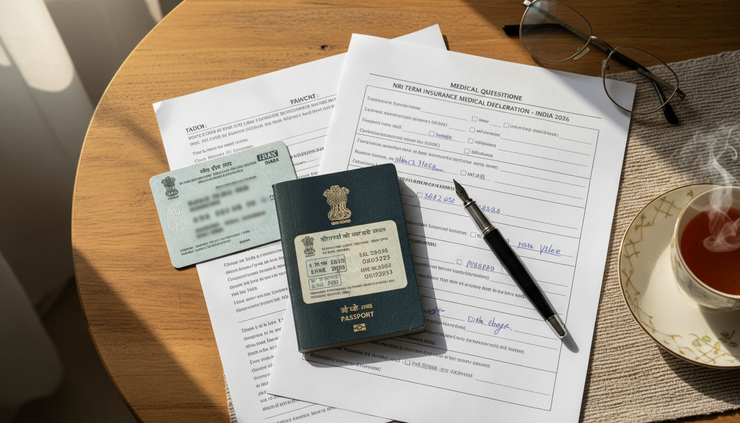
Documents and KYC needed for NRI life insurance
Documentation can vary by insurer, but a typical NRI life insurance India application may require identity, address, income and residential status proof.
Common documents include:
Document type | Examples insurers may ask for |
Identity proof | Passport, PAN, Aadhaar where applicable |
NRI status proof | Visa, work permit, residence permit |
Address proof | Overseas address proof and Indian address proof |
Income proof | Salary slips, tax returns, bank statements, employment letter |
Photographs | Recent passport-size photo or digital photo |
Medical records | Past reports, prescriptions or health declarations |
Financial documents | Loan statements, investment details, existing policy details |
For KYC, the insurer may need PAN details, overseas contact information, Indian contact details and tax residency declarations. Some applications may also involve video verification or in-person verification.
The proposal form must be accurate. If a person works offshore, travels frequently, has hazardous duties or has a serious medical history, those details should be disclosed. Claim teams review the original proposal at the claim stage. Incorrect answers can cause delays or disputes.
Medical examinations for NRIs
Medical underwriting helps insurers decide whether to issue the policy, load the premium, exclude certain risks where allowed, or decline the proposal.
For smaller cover amounts and younger applicants, some insurers may allow simplified underwriting. For larger covers, older ages or medical history, tests are more likely.
NRIs may have two broad options:
Complete medical tests during an India visit
Use approved medical facilities in the country of residence, if available
Medical exams may include blood tests, urine tests, ECG, blood pressure checks and other tests based on age, sum assured and health disclosures. Higher covers such as ₹3 crore may require more detailed underwriting.
NRIs should avoid rushing the purchase just before travel if medical tests are pending. A cleaner process is to plan early, keep medical records ready and respond quickly to insurer queries.
Nominee considerations for families in India
Yes, an NRI can nominate family members in India, subject to policy rules and Indian insurance regulations. Nominees may include a spouse, parents, children or other eligible persons.
Nomination deserves careful thought. The nominee is the person who receives the claim amount from the insurer. In many family situations, the nominee should be the person who will actually manage the money for dependants.
For example:
If parents in India depend on the NRI, one or both parents may be nominated.
If a spouse and child live in India, the spouse may be the primary nominee.
If the child is a minor, an appointee should be named to receive the claim on the child’s behalf.
If there are multiple dependants, percentage-based nomination can be used where permitted.
NRIs should keep nominee details updated after marriage, childbirth, divorce, death of a nominee or major family changes. They should also tell the nominee that the policy exists and where documents can be found.
Claim process and practical issues for NRI families
A claim is where the quality of preparation shows. Families in India should not have to search through emails, foreign bank accounts and unknown policy portals at a difficult time.
A life insurance claim may commonly require:
Claim form
Original or digital policy details
Death certificate
Identity and address proof of nominee
Bank account details of nominee
Medical records, if death was due to illness
Police report or post-mortem report, if death was accidental or unnatural
Overseas death certificate and related attestation, if death occurs outside India
If the death occurs abroad, documents may need translation, notarisation, embassy attestation or other formal steps depending on the country and insurer requirements. This is one reason NRIs should check claim documentation rules before buying.
A simple family folder can help. It may include policy number, insurer contact details, premium payment proof, nominee information and an explanation of what the policy is meant to cover.
Comparing Indian life insurance with cover in the country of residence
NRIs should compare Indian cover with local insurance in their country of residence. The right choice may be one policy, the other, or a mix of both.
Important comparison points include:
Factor | Indian term insurance | Country of residence insurance |
Currency of cover | Usually paid in Indian rupees | Usually paid in local currency |
Best fit | Indian dependants, Indian loans, Indian goals | Local spouse, rent, mortgage and living costs abroad |
Premium basis | Based on Indian underwriting and rules | Based on local market and rules |
Claim convenience | Easier for nominees in India if documents are ready | Easier for dependants living abroad |
Tax treatment | Depends on Indian tax rules and personal status | Depends on local tax law |
Medical network | India or insurer-approved overseas centres | Local medical network may be simpler |
Legal and estate issues | Linked to Indian nomination and succession rules | Linked to local estate rules |
The main question is not which country is better. The question is where the financial risk sits.
If an NRI has a mortgage, spouse and children abroad, local cover may be necessary. If the same person also supports parents and owns a home loan in India, NRI insurance India may still be useful. Cross-border families often need both sides reviewed together.
Tax is another point. Premium deductions, claim taxability and foreign asset reporting can vary based on residence status and local law. NRIs should take qualified tax advice in India and in the country where they live.

Common mistakes NRIs should avoid
Small errors can create big problems later. These are the mistakes to watch for:
Buying cover only because the premium looks low
Not disclosing NRI status or country of residence
Choosing a short tenure while long-term dependants remain
Ignoring Indian loans while calculating cover
Naming a nominee without discussing the policy
Letting premiums lapse due to payment issues
Forgetting to update contact details after moving countries
Assuming a rider works globally without checking terms
Keeping the policy secret from family members
Comparing plans only by claim settlement ratios or advertisements
A good term plan should be boring in the best way. It should be clear, correctly documented, affordable over the full term and easy for the family to understand.
A practical checklist before applying
Before buying life insurance for NRIs, review these points:
What Indian responsibilities would continue if income stopped?
Who depends on the NRI today?
How much loan balance remains in India?
What education, healthcare and living costs need protection?
How much existing insurance is already in force?
Is the cover amount financially justified by income and liabilities?
Are passport, visa, income and address documents updated?
Can medical tests be completed without delay?
Is the nominee the right person?
Will the nominee know how to claim?
Are premium payments easy to maintain from abroad?
How does the Indian plan compare with local cover abroad?
For personalised help, visit TrustCare Insurance for guidance on life cover linked to Indian financial responsibilities. TrustCare Insurance provides personalised insurance guidance to Indians and families with financial connections across India.
The key takeaway for NRI term insurance in 2026
NRIs can buy term insurance in India, including high-value covers such as ₹3 crore, if they meet the insurer’s rules and can justify the cover. The decision should start with dependants, loans, property and financial duties in India, not with a random premium quote.
The best policy is the one your family can claim when it matters. Choose the sum assured carefully, keep disclosures clean, complete KYC properly, plan medical tests early, review riders with caution and make nominee details clear. For NRIs with lives split across countries, thoughtful planning can turn a term plan from a document into real financial security.


Comments